


When the AI layoff stories hit, most lawyers file them under “tech, not us.” Two stories this week say otherwise, and they point at the same shift.
Cloudflare cut more than 20% of its staff, and its CEO explained the logic in the Wall Street Journal using three buckets he borrowed from Drucker. Builders make the product, and they stay, because AI multiplies a good engineer. Sellers close deals, and they stay, because budgets still move on trust between humans. Measurers track, control, and enforce compliance. They got cut. His list of Measurers named admin, finance, middle management, and legal.
The same week, Box CEO Aaron Levie read Kirkland’s $500 million AI investment and named the deeper pattern. Once the models commoditize and every competitor can rent the same intelligence, advantage stops living in the technology. It moves to how well you harness what is uniquely yours: your institutional knowledge, your relationships, your judgment.
Put the two together and the picture for legal is clear. The execution layer, the reviewing and the oversight a counsel grinds through every week, is compressing. Not only in BigLaw. The boutique and the three-person legal team feel it too, because they never had a pyramid to hide in.
How most people respond
Two reflexes, both wrong. The first is to buy a tool, run a pilot, and call it transformation. Nicola Shaver pointed out thi
s week that firms benchmark their AI spend against other firms, which she compared to grading on a curve in a class where everyone failed the exam.
The second is to hear “become a builder,” assume it means learning to code, decide that ship sailed in law school, and opt out.
Why both miss
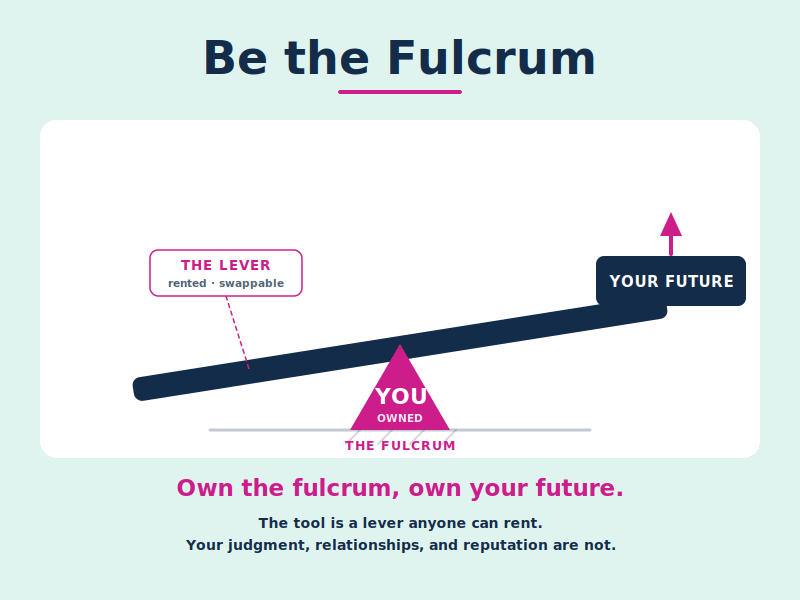
They both stare at the lever and ignore the fulcrum.
A tool is a lever. The models behind it are everyone’s now, which is exactly Levie’s point. The lever is not the advantage. And “builder” was never a synonym for software developer. A builder is the lawyer who stops seeing only tasks and starts seeing systems, then uses any tool as a lever on a fulcrum that stays theirs.
Two lawyers get the same AI vendor tool. One uses it to clear the queue faster and ends the quarter where she started, just less busy. The other uses it to take on the matters that deepen her best client relationship, and builds a simple system that captures how she handles them. Next quarter she is faster still, the client trusts her more, and the system is hers. Same lever. One set it down. The other bolted it to a fulcrum no one can take.
What actually works
The models are everyone’s now. What’s left to own is your unique value: the judgment, the relationships, the reputation no tool can encode. You don’t own that by building or by buying. You own it by making sure every tool you touch is a lever on a fulcrum that stays yours. Rent the lever. Own the fulcrum. Become indispensable to the value, not the tool.
This lands at two levels.
At the business-model level, a firm owns its value by harnessing its proprietary assets, whichever AI it runs them through. Shaver gives the map. She splits legal tech investment into four portfolios: foundational systems, third-party tools you license, build-and-differentiation, and R&D. The licensed tools are levers every competitor can rent. Build-and-differentiation is where the fulcrum gets made, and it is the portfolio most firms starve while pouring everything into the levers and then wondering why they look like everyone else. In legal the deepest proprietary asset of all is the relationship. A client picks Kirkland over a strong AmLaw 150 firm not for a better playbook but for trust, reputation, and the partner they believe. Kirkland’s $500 million is not a tool purchase. It is the apparatus that lets that trust scale and survive turnover. The tools inside it are swappable. The value they protect is not.
At the individual level, the same rule runs your career:
Name your fulcrum. The relationships, the judgment, the reputation that are yours and compound. If you can’t say it in a sentence, that’s the first thing to fix.
Make every matter accrue to it. The test for any piece of work: did it sharpen my judgment, deepen a relationship, or add to a system I control, or did it just clear a queue? Clearing a queue builds nothing you own.
Stay tool-agnostic. Don’t become the Harvey lawyer. Become the lawyer Harvey makes more valuable. The moment your identity is a vendor’s product, your value belongs to their roadmap.
Don’t let it leave the building. Run the commodity work through rented tools. Keep the rare part, the decision logic and the client trust, on your side of the line.
Three moves this week
Write your fulcrum in one sentence. The value that is yours, that no tool encodes.
For the next tool you reach for, name where the value lands when you are done: with you, the vendor, or no one. Lean on it where the answer is you.
Take one task you own by hand and map it as a system: inputs, rules, decisions, exceptions. Seeing it as a system instead of a chore is the entire builder shift. No code required.
The stack of people compresses. The work doesn’t, and there is plenty of it. It will go to the lawyers who aid the machine or sit in judgment on top of it, never to the ones doing what the machine now does. Builders matter because they refuse to see the world as pure execution. Rent the lever. Own the fulcrum. Be indispensable to the value, not the tool.