
I Already Built an AI-Native Law Firm. It Just Didn't Have Any AI.
What Camber Legal taught me about outcome pricing, and how I'd rebuild it as a data layer today.

Camber Legal was not a technology company. It was a collections shop for corporate legal departments. But the thing I spent the most money and time on, and the thing that made the economics work, was the custom workflows we built inside Microsoft teams. When I read about AI-native law firms in 2026, I recognize the shape. I already ran one. I just didn't have the tooling we have now.
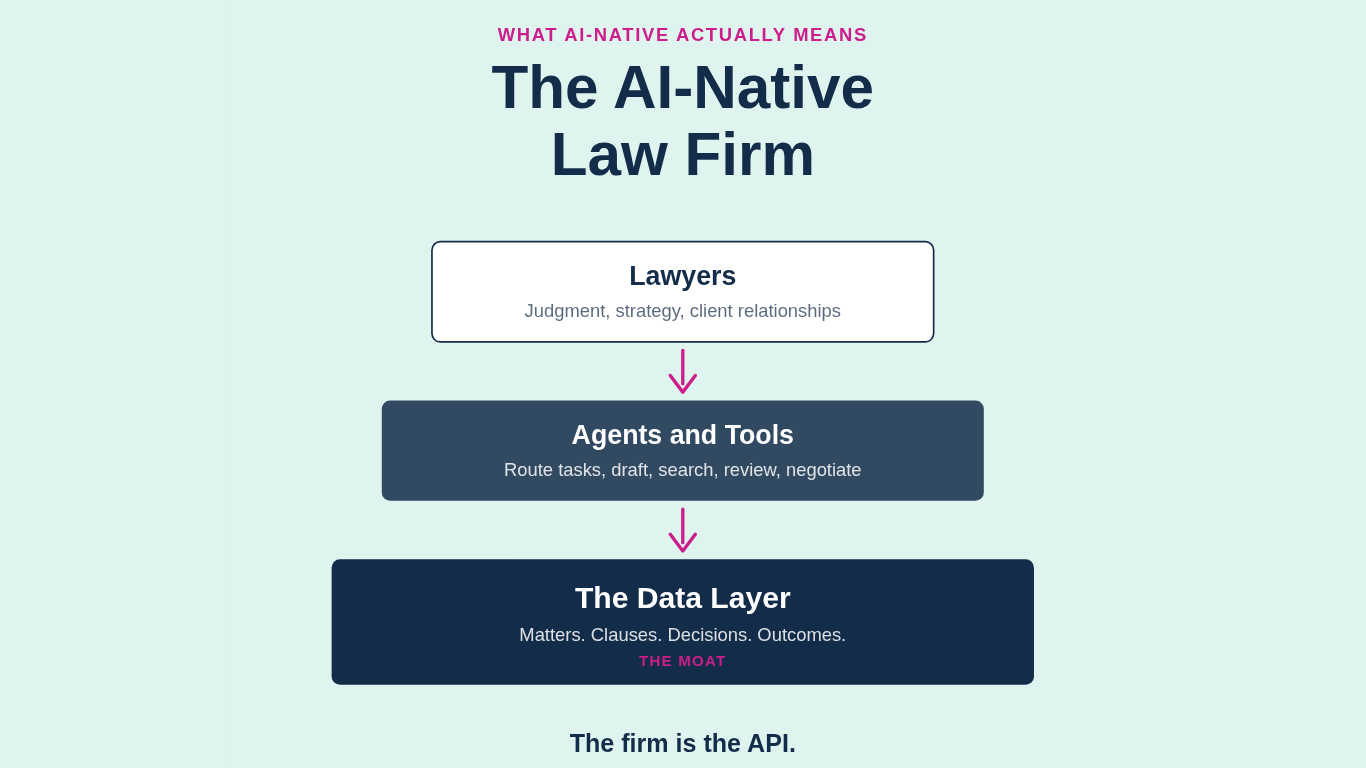
Camber was a hybrid firm. B2B collections. High volume. Large corporate clients who wanted predictable outcomes on receivables portfolios they had already written down. We sold on a subscription with alternative fees tied to recovery, not hours. Our value metric was outcomes. Time never showed up on an invoice.
To deliver that, we built. Complaint drafting engines that pulled account data, computed balances, attached exhibits, and output a pleading ready for local counsel review. Demand-letter A/B models that learned which openings, amounts, and payment-plan structures moved debtors into settlement faster. A negotiation ledger that tracked every counter, every concession, every close, so the next collector started smarter than the last one.
The lawyers still made the calls. But the firm itself was the knowledge system. The legal work I did got inputted into the system. The system improved, and so the work I did improved. Outcomes delivered to happy clients. The system carried what used to live in my head.
That is what people now call AI-native. Not the AI part. The part where the firm stopped pricing time and started pricing outcomes, because the knowledge layer made outcomes repeatable.
The rebuild
If I started Camber today, I would not rebuild the complaint engine first. I would rebuild the data layer the engine sat on. And I would build it so every piece of it, every clause precedent, every negotiation state, every settlement pattern, every case outcome, lived behind an API an agent could hit.
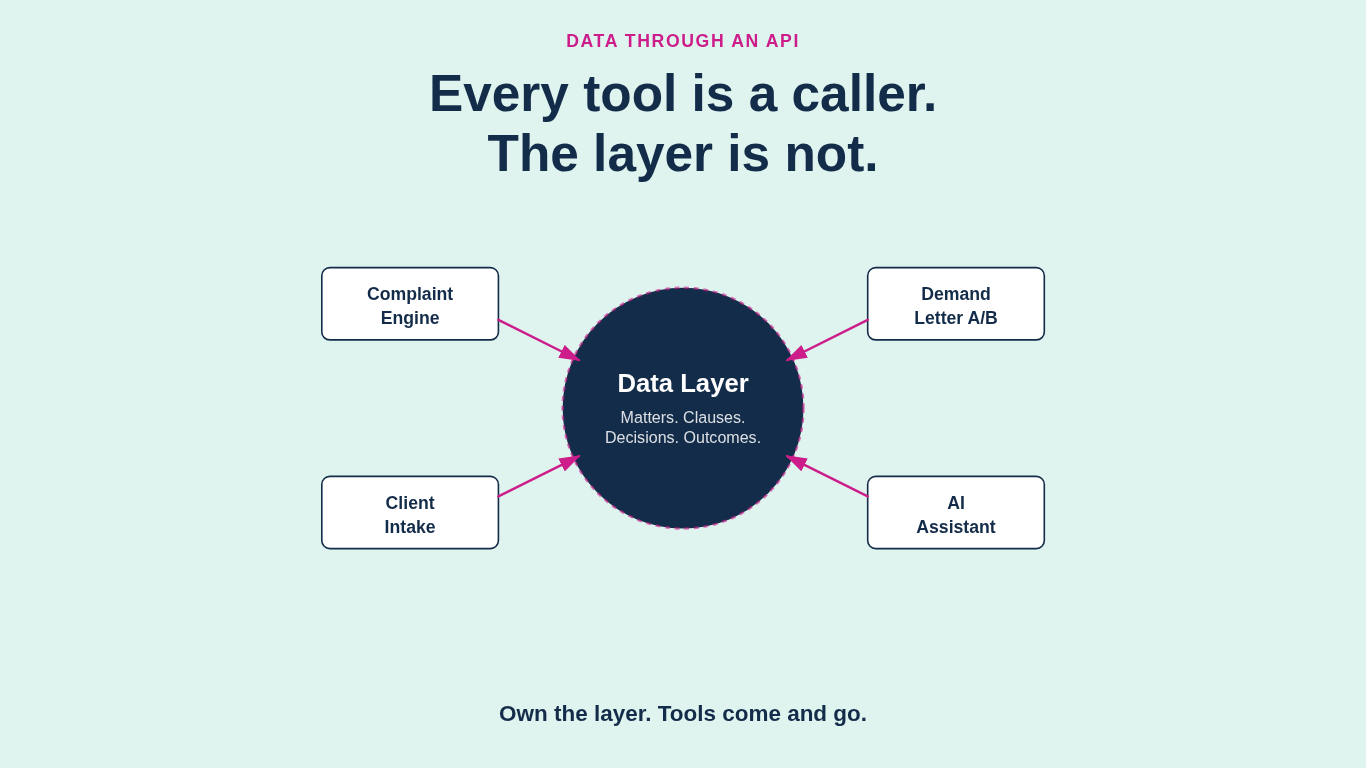
Every tool the firm runs would sit on top of that layer as a small app that read from it and wrote results back. The complaint engine would be one of those apps. The demand-letter A/B tool would be another. A future AI assistant I have not thought of yet would be another. None of them would hold the firm's knowledge. The knowledge would live in the layer underneath, and every tool would just be a different way to ask it something.
That is the reframe Artificial Lawyer described when they wrote about orchestrator agents breaking problems into parallel tasks, and the reason Legal Paradox, the firm the IBA flagged as the first fully AI-native law firm, can run six lawyers against work that used to take thirty. Their LPA reviews run $900 a document, about 90% below traditional pricing. That economics only works because the firm is the API. Requests come in structured. Agents route across the data layer. Lawyers review and exercise judgment. Results write back. The next matter costs less than the last one.
Foundation Capital calls this the context graph. Every decision captured becomes searchable precedent. Every automated action adds a trace. The firms that own their data layer own their reasoning. The firms that don't will hand that reasoning to whichever vendor sits in their execution path.
The stack I would actually build
Four layers, built in this order.
A structured database. The foundation. Normalized records of matters, clients, contracts, documents, and decisions. Hosted somewhere the firm controls, not inside a vendor's product. $25 to $600 a month depending on volume.
A search layer. Finds documents and clauses by meaning, not just keyword match. Usually runs inside the same database. Costs little to nothing to start.
A workflow engine. Routes documents between systems, triggers automations, and connects to an internal platform that leverages agents as our practice management platform. $0 to $50 a month.
An access layer. The API gateway on top that exposes the data and workflows to any AI assistant the firm authorizes. Today's assistant connects through it. Tomorrow's assistant connects through it. The firm's own internal tools connect through it. All of them read from and write to the same data underneath.
Total infrastructure cost for a small-to-mid firm: $150 to $1,500 a month. A single seat on one of the enterprise legal AI assistants runs in the low thousands per user per month.
Build order
Weeks 1 to 6. Pick the highest-volume workflow and structure the data. For Camber today, that would still be collections intake. Parties, balances, account histories, tolling dates, venues, prior correspondence, all normalized and queryable. Find your expertise, the workflow you use every day and know cold.
Months 2 to 4. Build one internal tool that reads from the layer. A redline surface, a settlement recommendation, a demand-letter generator. A couple days worth of work with modern AI-assisted coding tools. Lawyers get a tool that works against the firm's precedent in the firm's language, not a generalized vendor model.
Months 4 to 9. Expand the corpus. Leverage free data through MCPs and APIs to improve your workflow. Stanford's Material Contracts Corpus (more than a million contracts with normalized parties and agreement types) gives a reference schema for the contract side. Or leverage all the data inside the Alea Institute’s datasets. Automate ingestion of new matters so the system gets smarter without anyone writing a weekly report.
Month 9 onward. Evaluate vendors against the firm's data layer, not inside theirs. If an assistant cannot query the firm's API or write results back to it, the firm knows what it is buying.
What Camber was really selling
What Camber sold was outcomes. What the AI-native firms are selling is also outcomes. The shift is not that AI showed up. The shift is that outcome pricing finally has the substrate it needed. A firm whose knowledge compounds inside a queryable layer can price against results because the layer makes results repeatable.
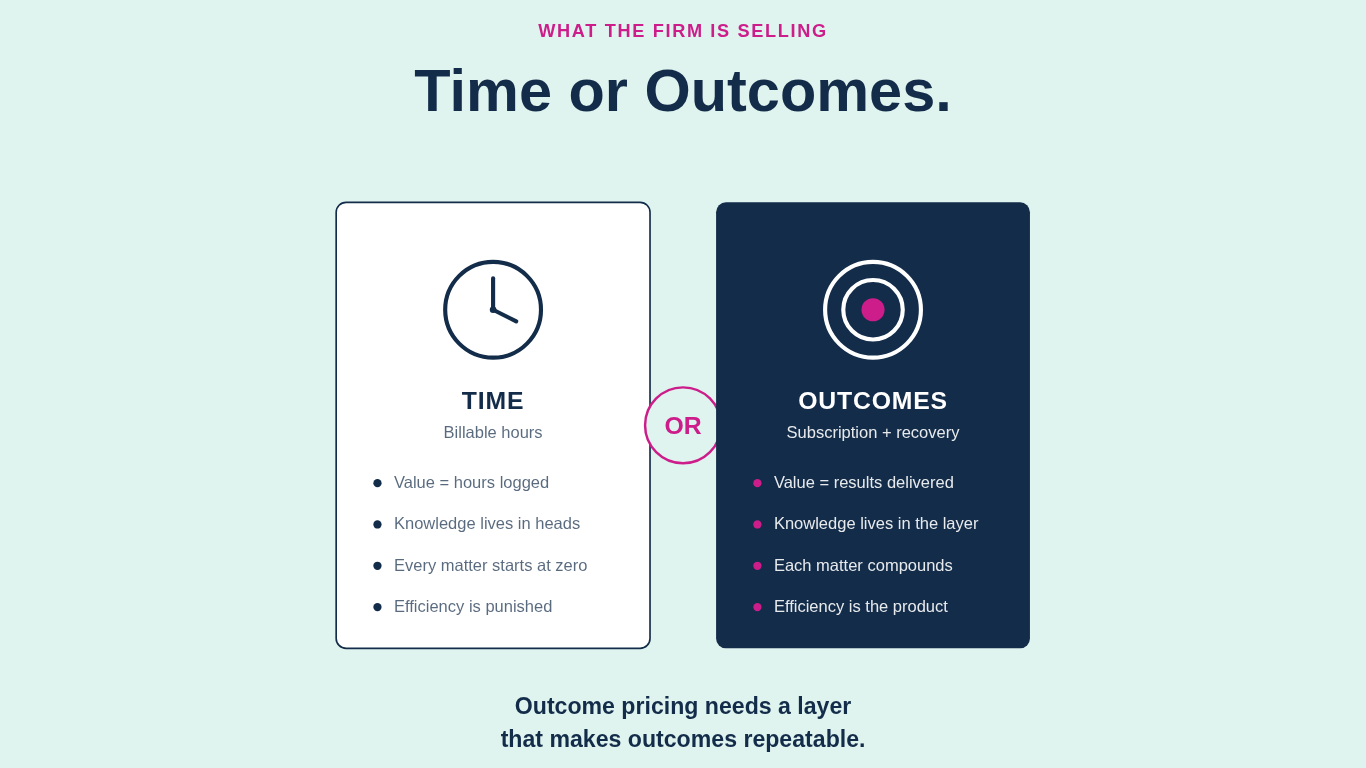
If I started now, I would not build another hybrid firm. I would build a data platform that happens to employ lawyers, sell subscription access to specific matter outcomes, and let the data layer carry the reasoning the firm used to rebuild from scratch every matter. The firm that owns that layer owns the client relationship. Every tool on top is swappable. The layer is not.