


Part 1 of 2: What Job Does a Lawyer Get Hired For?
The legal professionals who will thrive in the next decade won’t be the ones who know the most. They’ll be the ones who build the best systems.
Not systems as in software. Systems as in: repeatable ways to deliver confidence, speed, and outcomes that clients actually pay for. The professionals who think in workflows instead of tasks. Who design their practices like architects instead of patching problems like on-call fixers.
This isn’t a prediction. It’s already happening. Harvey AI hires “Legal Engineers” with both BigLaw experience and systems design skills. Linklaters built an entire Practice Innovation team. Stanford is running Agentic AI bootcamps for law students. Artificial Lawyer just called “vibe coding lawyers” the dominant conversation at legal tech gatherings.
But why? Why now? Why does the builder’s advantage compound specifically at this moment?
Because AI just exposed a truth the profession has been dancing around for decades: the job clients are hiring lawyers to do has never been the job lawyers think they’re selling.
And if you can’t see the real job, you can’t build the system to deliver it.
There’s a framework for this. It comes from a man who spent 18 hours watching people buy milkshakes.
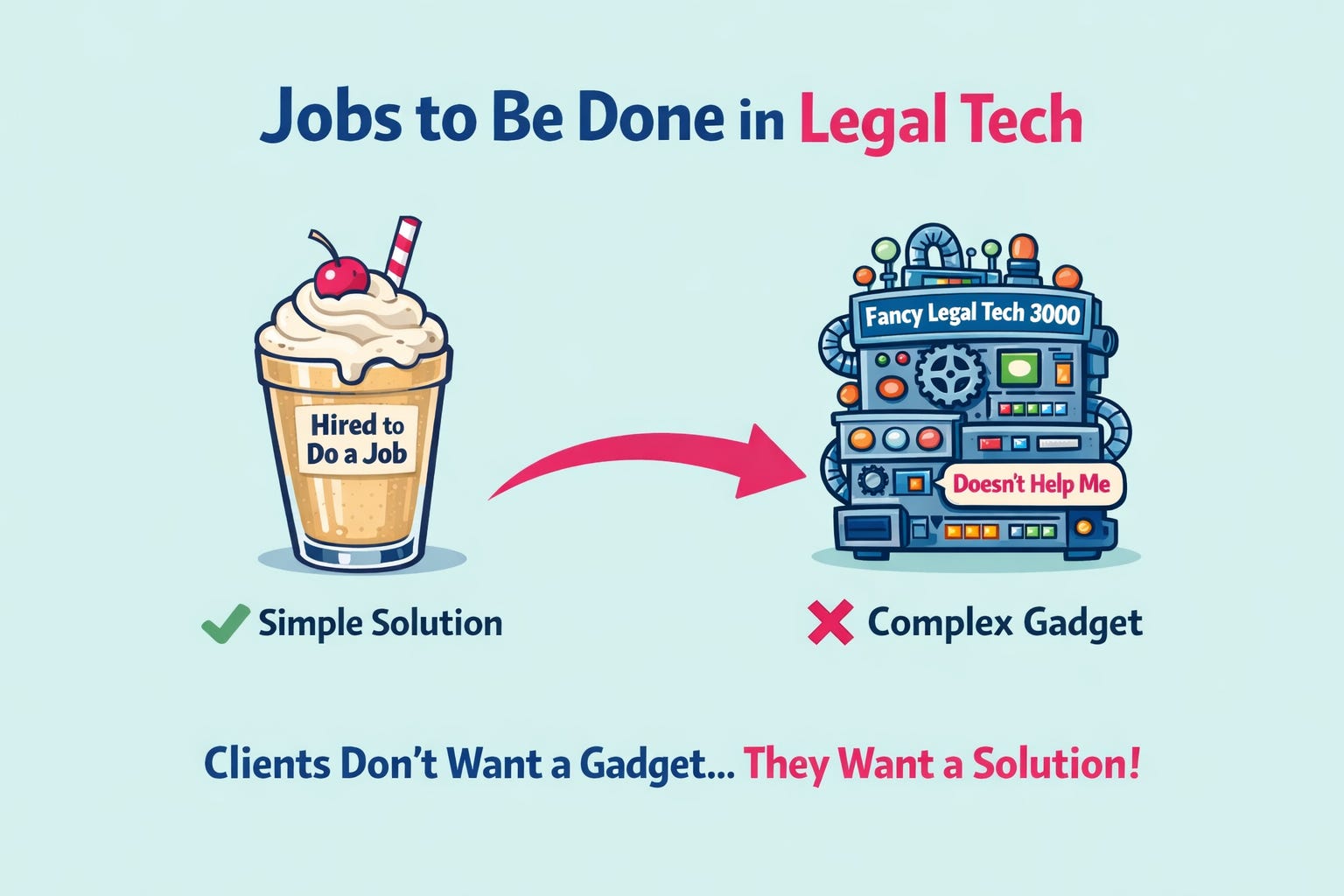
The milkshake, the commuter, and the job
Clayton Christensen’s team sat in a fast-food restaurant watching milkshake purchases. They’d already tried the obvious approach. Survey customers. Improve the product. Chocolatier. Cheaper. Chunkier. Sales didn’t move.
But the observation changed everything. Half of all milkshakes sold before 8:30 AM. Lone commuters. No kids. Straight to the car.
When asked what “job” they hired the milkshake to do, nobody said dessert. The job was: keep me occupied during a boring 40-minute commute. Something thick enough to last, interesting enough to break the monotony, easy enough to handle with one hand on the wheel.
The milkshake wasn’t competing with other milkshakes. It was competing with bananas, bagels, and silence.
When they redesigned around the actual job, sales went up seven-fold.
This is Christensen’s Jobs to Be Done framework. Customers don’t buy products. They hire them to do a job. And every job has three layers:
The functional job is the task. Draft the contract. Research the precedent. Close the deal.
The emotional job is how the buyer wants to feel. Confident they haven’t missed anything. Protected from exposure. Less anxious at 11pm about what they might have overlooked.
The social job is how they want to be perceived. Competent to their partners. Credible to the board. Defensible in their decisions.
Most legal technology, law firm marketing, and career development focuses on the functional layer. Faster research. Smarter review. More efficient workflows.
But the functional job is almost never the reason someone hires a lawyer, buys a legal tech product, or decides whether to adopt a new tool.
The emotional and social jobs are.
This is why builders win. Because building a system requires understanding the real job. Reacting to tasks only requires understanding the stated one.
Let me show you what this looks like.
Four people. Four real jobs. Four opportunities to build.
The GC who isn’t buying expertise
New GC. Fortune 500 company. Inherited a panel of twelve outside firms. The CEO wants outside counsel spend cut 15% without increasing risk.
She could negotiate rates. Consolidate the panel. Bring categories of work in-house. The data says 64% of in-house counsel expect to reduce reliance on outside counsel with help from AI.
But here’s what she’s actually navigating at 2 PM on a Wednesday when the head of sales calls about a customer threatening litigation over a failed implementation.
She’s not thinking about rate cards. She’s thinking: who do I call that will pick up immediately, understand the business context without a 45-minute download, and give me a confident recommendation I can relay to the sales VP before his 3 PM meeting?
Speed. Context. Confidence she can hand to a non-lawyer who needs to make a business decision in the next hour. That’s the job.
The firm that wins this work won’t be the one with the lowest blended rate. It’ll be the one that has built enough context about her business that the 2 PM call takes 12 minutes instead of 45. That’s a knowledge architecture problem. It requires compounding relationship context over time through tooling and workflow design, not just good lawyers with good memories.
And she’s navigating a social job she’ll never say out loud. If she consolidates the panel and one of the cut firms was handling a matter that blows up six months later, she owns that outcome. If she keeps the incumbent and it goes sideways, the decision is defensible. This is the “nobody gets fired for hiring IBM” dynamic, and it shapes GC behavior far more than any pricing conversation.
The builder’s advantage for this GC: design an intake and triage system that routes work based on actual complexity, not relationship inertia. Build a knowledge base that captures firm-specific context so the 2 PM call never requires a 45-minute download. Architect the panel around jobs to be done, not practice area labels.
The GC who doesn’t build will keep managing a panel through spreadsheets and instinct, and the CEO’s 15% target will remain a negotiation exercise instead of an operating model.
The legal ops lead who solved the wrong problem
Legal ops. Mid-size legal department. She spent four months evaluating CLM platforms. Business case approved. Vendor selected. Implementation started.
Eight months later, adoption is at 40%. Sales still emails contracts as attachments. Half the legal team routes around the system. Her business case is underwater.
She didn’t fail at technology selection. She failed at job identification.
The CLM vendor said the job was “manage contracts from creation to renewal.” That’s the vendor’s job. It was never the user’s job.
Sales wants to close the deal before quarter-end. Legal wants to approve without being the bottleneck. The CFO wants to know what the company is committed to without asking legal. Three different people with three different jobs. None of them is “adopt a cross-departmental workflow platform.”
Bob Moesta, who co-created JTBD with Christensen, explains why this happens. People switch products when the push of dissatisfaction plus the pull of the new exceeds the anxiety of change plus the habit of the present. CLM carries massive change anxiety: 12-to-18-month implementations, mandatory retraining, systems that collapse with outside parties who won’t adopt your workflow. And the habit of email-plus-Word is so entrenched it might as well be muscle memory. The math never closes, no matter how good the demo was.
The builder’s advantage for legal ops: stop evaluating platforms. Start mapping jobs. Build lightweight, modular systems that serve each stakeholder’s actual job without requiring behavior change that nobody signed up for. An NDA self-service portal for sales. An approval queue for legal. A reporting layer for the CFO. Three small systems that each serve a real job, built incrementally, instead of one monolithic system that serves a vendor’s vision of the job.
Gartner says nearly half of CLM implementations fall short. Christensen estimated 75-85% of new products fail because they miss the real job. Same root cause. The legal ops leaders who succeed won’t be the best tool pickers. They’ll be the best job identifiers.
The associate who isn’t worried about research
9:45 PM. Fourth-year associate. Transaction closing Friday. The partner forwarded diligence documents at 6 PM with a note: “flag anything unusual by morning.”
She’s not worried about whether she can find the issues. She’s been reviewing data rooms since her first year. She’s good at this.
She’s worried about what she might miss.
That’s the emotional job. Not “review these documents.” The job she’s actually doing at 9:45 PM is: build enough confidence that when she sends the memo at 7 AM, she won’t get the call at 10 AM about the change-of-control provision buried in an amendment to Schedule 4.
Now put Harvey or Legora in front of her. The vendor pitch is speed: “Review a data room in hours instead of weeks.” Fine. That’s the functional job.
But that’s not why she’d use it. She’d use it because it gives her a second pass. A safety net. Something to compare her own work against. The real job the tool is hired for: reduce the anxiety that I missed something.
A lawyer who understands this builds differently. She doesn’t just use the AI tool. She designs a validation workflow: her review, the AI’s review, a structured comparison that catches discrepancies. She builds a process she can run on every data room, every time, and hand to a junior associate who can execute it with the same confidence.
That’s the builder’s advantage. She didn’t just get faster. She designed a system that produces verifiable, repeatable assurance. The next deal, and the one after that, and the one after that, all benefit from the architecture she built tonight.
The associate who doesn’t build? She’ll use the tool ad hoc, feel a little less anxious, and start from scratch on the next deal.
The solo practitioner who isn’t practicing law
Solo. Family law. She does good work. The problem is she only gets to do it 55% of the time.
The rest is intake calls, calendar management, billing, follow-ups, client communications, and bookkeeping. Clio’s data shows the average lawyer bills 2.9 hours in an 8-hour day. She’s losing over $100,000 a year in time that never reaches a client.
When she looks at AI tools, the vendor pitch is “draft documents faster.” But drafting isn’t her problem. She drafts fine. Her problem is she can’t get to the drafting because everything else eats her day first.
Her real job to be done for technology: help me run a business when all I was trained for is practicing law.
The builder’s advantage here is the most tangible of all. She doesn’t need to become a software engineer. She needs to look at her practice as a system with inputs, processes, and outputs instead of a collection of individual matters. Where are the bottlenecks? What repeats? What can she automate not by buying a single tool but by designing a workflow?
A lawyer who builds an intake automation that connects to scheduling, routes to a document assembly pipeline, and triggers a client communication sequence has done something more powerful than adopting any single product. She’s built an operating model. She’ll recover those lost hours not by working faster, but by designing her way out of work that never required a licensed attorney in the first place.
The solo who doesn’t build will keep losing half her day to admin and wonder why revenue stays flat while she works harder.
The pattern underneath
Every one of these people faces the same gap.
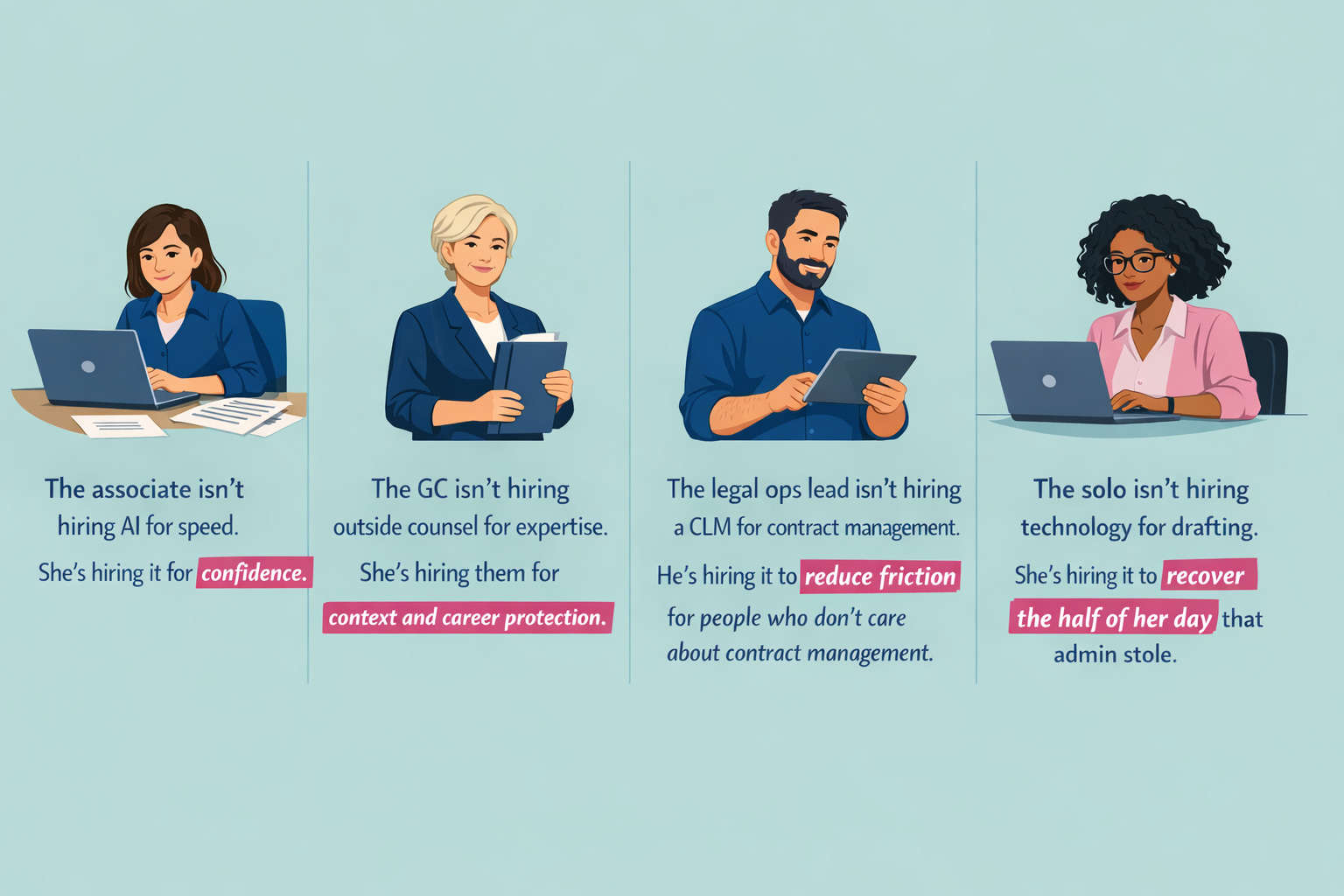
The associate isn’t hiring AI for speed. She’s hiring it for confidence. The GC isn’t hiring outside counsel for expertise. She’s hiring them for context and career protection. The legal ops lead isn’t hiring a CLM for contract management. She’s hiring it to reduce friction for people who don’t care about contract management. The solo isn’t hiring technology for drafting. She’s hiring it to recover the half of her day that admin stole.
In every case, the real job is emotional or social, wrapped inside a functional request. And in every case, the person who wins is the one who identifies the real job and builds a system to serve it.
This is why the builder’s advantage isn’t just a career differentiator anymore. It’s becoming the dividing line.
The legal profession is converging with software thinking. Not because lawyers need to write code, though that’s increasingly useful. Because the skills that create value in a world where AI handles the functional layer are the same skills engineers have been developing for years: systems thinking, workflow design, architecture that compounds, processes that scale.
The lawyer who can identify the real job, design a system to deliver it, and build the workflow that produces repeatable outcomes isn’t just more efficient. They’re playing a different game. They’re not fixing today’s problem. They’re building tomorrow’s operating model.
Moesta said it plainly: “Adding more features is not better because it causes additional anxiety.” In a profession organized around risk aversion, more features means more anxiety, more switching costs, more reasons to stay with email and Word. Builders cut through that by designing around the real job. Fewer moving parts. Less behavior change required. Higher confidence delivered.
The firms, legal departments, and solo practices that internalize Jobs to Be Done will make different technology decisions, different hiring decisions, and different career bets. They’ll stop asking “what does this tool do?” and start asking “what job is this person actually trying to accomplish, and does this tool serve that job or add anxiety to it?”
That one question is worth more than every feature comparison matrix ever built.
In Part 2, we’ll take this framework and apply it to the economics: what happens to the billable hour when the job gets done in one-tenth the time, and why the answer isn’t only flat fees. It’s an ever escalating hourly rate that neatly fits into current procurement team systems and should make managing partners very interested.
One move: pick one task you did this week. Don’t describe the task. Describe how you wanted to feel when it was done. That feeling is the real job. Now ask whether your current tools and workflows serve that job, or just the task.