
The Bridge to Outcome-Based Pricing Looks Exactly Like a Billable Hour

Part 2: What Job Does a Lawyer Get Hired For?
The billable hour is a container.
That’s the insight I missed for years, and the one I think most of the profession is still missing. The hour was never the point. It’s the packaging. And the legal industry is arguing about whether to throw out the packaging while ignoring the fact that what goes inside it is about to change completely.
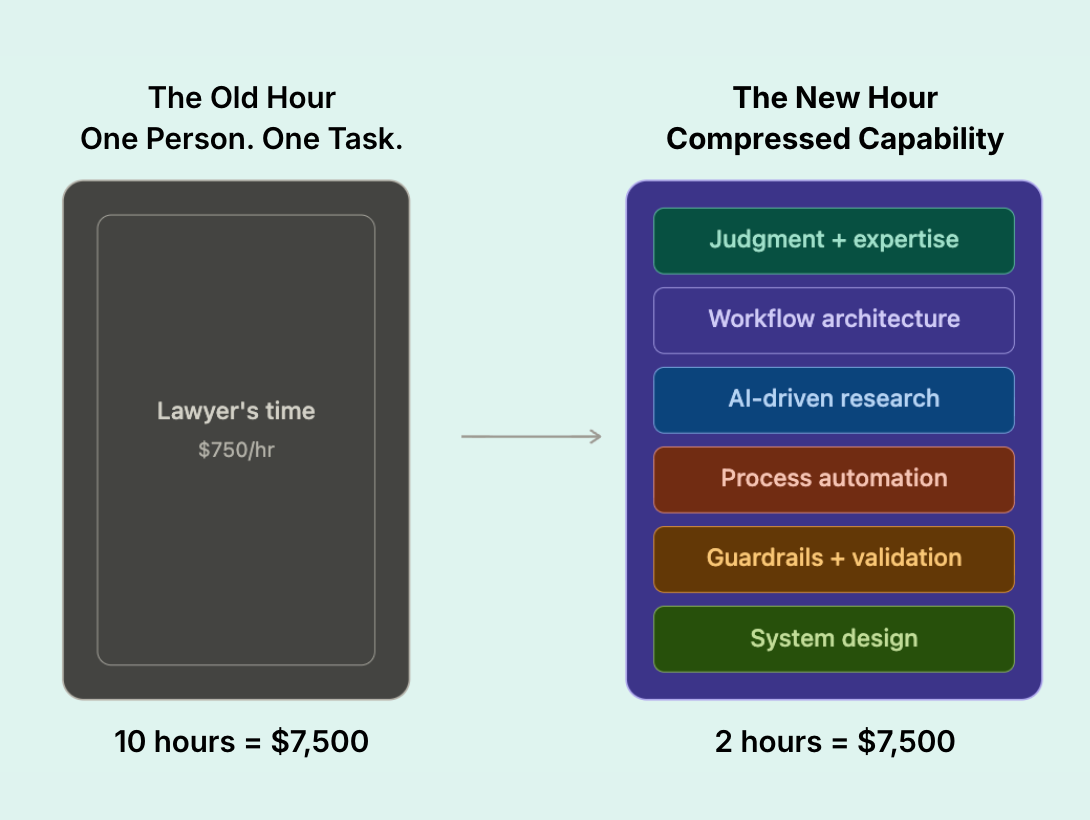
For decades, the billable hour contained one thing: a lawyer’s time. One person, one desk, one task, one increment of effort measured in six-minute blocks.
That container is about to hold something very different. The technology investment. The workflow automation. The work that junior associates used to do. The AI-driven research and drafting that used to take a team a week. The judgment that makes the output trustworthy. The expertise that took 15 years to build. All of it, packed into a single unit of billing that procurement can process, finance can accrue, and the general counsel doesn’t have to fight for internally.
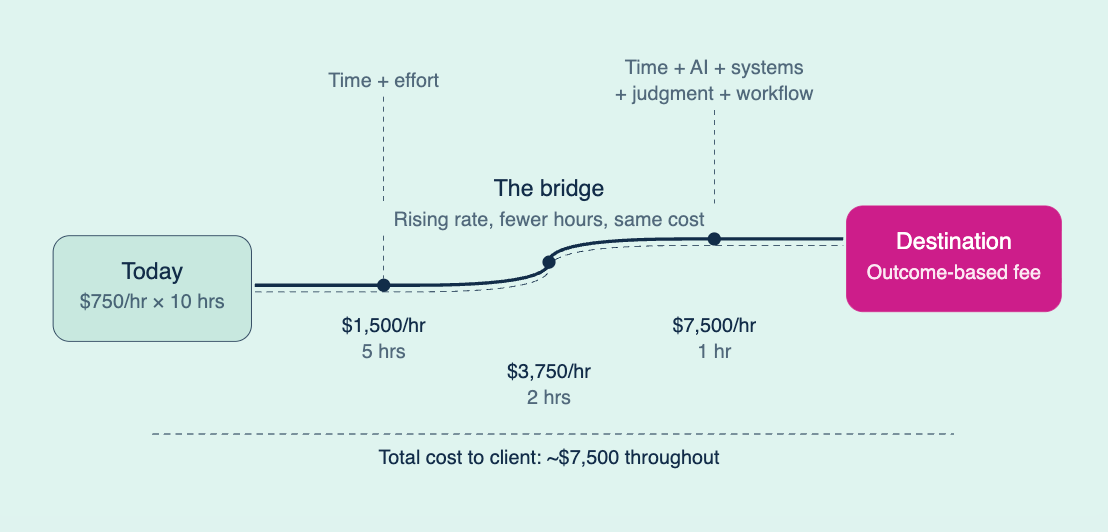
The rate goes up. The hours go down. The total cost stays roughly the same.
This isn’t the final destination. Eventually, the profession will arrive at true outcome-based pricing. But that transition requires infrastructure that doesn’t exist yet: new billing systems, new data standards, new ways for finance teams to accrue and report and allocate. That takes years.
In the meantime, the billable hour is the bridge. And everyone will be fine walking across it, because they know what’s inside: the full capability, not just a person sitting at a desk.
I know this because I tried the alternative. I built the better model. And I watched it break against the exact infrastructure that the billable hour slides through without friction.
The model that should have worked
In Part 1, I told the story of Christensen’s milkshake and the Jobs to Be Done framework: every hiring decision has a functional layer, an emotional layer, and a social layer, and if you only see the functional job, you build the wrong thing.
When I was building Camber Legal, my subscription-based B2B collections litigation company, I wish I’d had that framework. Not because it would have changed the model. But it would have changed how I sold it.
Camber Legal was a hybrid law firm and legal tech offering. We built process automation inside Microsoft Teams to deliver legal services through a monthly subscription. Collections litigation has massive volume but terrible economics on an hourly basis. The amount in dispute often doesn’t justify the legal spend to recover it. We flipped the math: a minimum viable subscription tied to success fees on recoveries, and then it was on us to drive profit by automating everything we could.
Clients saw the value immediately. The work product was strong. We were recovering money that would have otherwise been written off.
And then we’d walk into a meeting with a Fortune 500 legal department, and the conversation would go sideways in the last 15 minutes.
The wall was three walls
The general counsel got it. The lawyers managing the collections portfolio wanted to start yesterday.
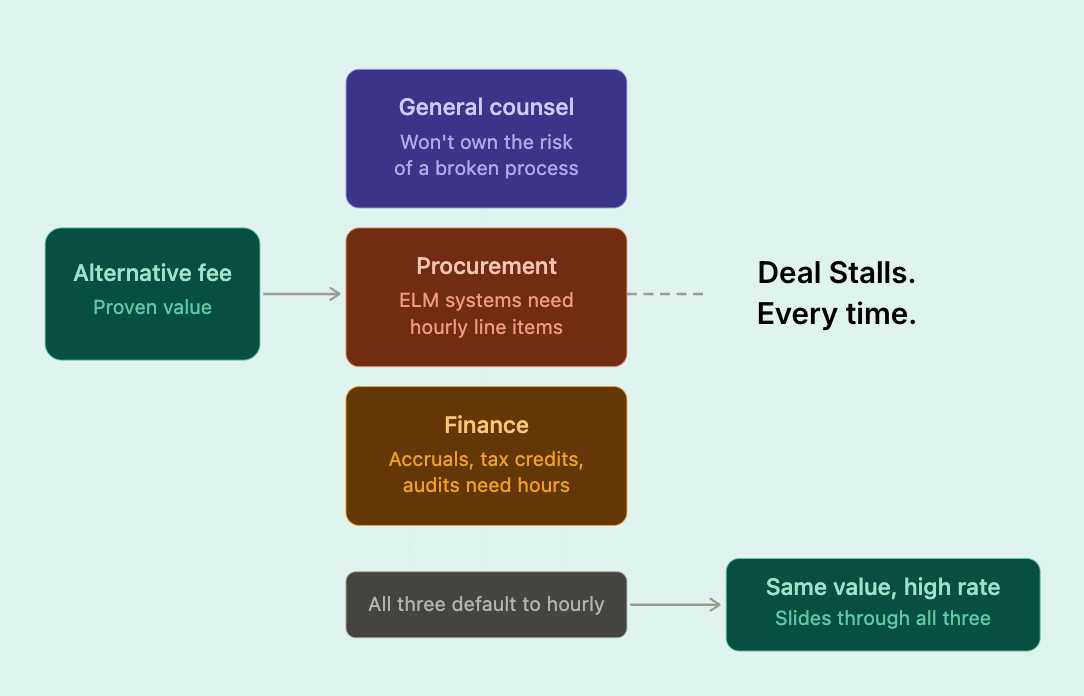
And then the deal would stall. Not in one place. In three.
Procurement: “We only do hourly billing. We could look at an alternative fee, but we’d need you to track your time.”
Finance: “How do we accrue this? Our systems need line-item data.”
And the GC’s office would quietly step back. Not because they stopped believing in the value. Because they didn’t want to be the person who forced a non-standard vendor through a process that wasn’t built for it. If something went wrong downstream, a reporting issue, an audit flag, a budget variance, the decision traced back to them.
Every time. Not one gatekeeper. Three. Each with a legitimate reason. None about the quality of the work.
I refused to track time. Any hour we spent documenting our work for someone else’s accounting system was an hour not spent on the actual work or building the technology. That tracking didn’t create value for the client. It created data for a back-office workflow designed to audit hourly invoices.
I thought the problem was cultural. I was wrong. The problem was structural.
Why the container is hourly-shaped
Enterprise Legal Management platforms were architecturally built to audit hourly invoices. Their core function is validating line-item data: which timekeeper, what rate, which task code, how many six-minute increments. Even a modern platform like Brightflag, which supports fixed-fee submissions as a separate workflow, still processes nearly half of all US-headquartered client invoices as PDFs. The most widely used billing format, LEDES 1998B, has 24 fields almost entirely built around hourly timekeeping. It doesn’t support alternative fee arrangements at all.
But the problem compounds downstream. Finance needs to accrue legal costs monthly. With hourly billing, that’s straightforward: hours times rate. With a flat fee, the “percentage complete” question has no clean answer. How much of a $50,000 subscription has been “earned” by month three? Without hourly data as a proxy, the accrual becomes a guess. Fortune 500 finance departments don’t guess.
Tax teams need granular data too. R&D credits require evidence of time on qualified activities. GAAP rules require certain legal costs to be capitalized, not expensed, and that requires activity-based proof. The CFO’s office doesn’t care whether the billable hour measures legal value. They need data that fits their reporting systems. Those systems speak one language.
And the GC, caught in the middle, does the rational thing: defaults to hourly. Not because it’s the best deal. Because it’s the only model where every system and every stakeholder works without a workaround.
Companies even agree to flat fees and then require law firms to submit shadow invoices showing the hours anyway. If the firm uses technology to finish faster, the shadow bill shows fewer hours, and the client uses that to negotiate a lower fee next time. The firm gets penalized for the efficiency the alternative fee was supposed to reward.
I was selling to the person who valued the outcome while ignoring the people who controlled the process. In a Fortune 500 company, process wins every time.
What goes inside the container now
Jessica Markowitz, President and COO of Paragon Legal Services, got me noodling this idea in a LinkedIn post a few months back. The billable hour rate structure will simply continue to rise. Technology, process automation, the work that junior associates used to do: all of it folded into the hourly rate. The hour becomes a function for evaluating value, not a measure of labor. It works because it’s easier for the law firm and easier for the corporates.
That clicked for me, because I lived the opposite experience. I tried to deliver value outside the container, and the container won.
If I’d priced Camber Legal’s work as a very high hourly rate with a guaranteed estimate of hours, the total cost would have been identical. “This matter will take 10 hours at $5,000 per hour. If we finish in 8, you pay for 8.” Procurement could process it. Finance could accrue it. The GC wouldn’t need to spend political capital getting a non-standard vendor past three teams. Same value. Different container.
Generative AI makes this math real. When I built Camber Legal, it was before the current generation. The compression wasn’t dramatic enough to make a very high rate look reasonable. The work still took meaningful time.
Now? A task that used to take 10 hours at $750 per hour generated a $7,500 bill. AI compresses that to one or two hours. The rate goes to $3,750 or $7,500 per hour. Same total bill. The line item still says “2.0 hours” and every system in the building can process it.
Am Law 25 partners already bill over $2,000-$4,000 per hour. Rates have been climbing 7 to 9 percent annually. AI just makes the compression honest: the rate reflects the capability being delivered per unit of time, not the labor.
Jeff Bleich, Anthropic’s General Counsel, said it plainly at the ABA White Collar Crime Institute: the billable hour has been dying for a long time, and AI will accelerate that death. He’s right about the acceleration. But I think the more interesting development isn’t whether the hour dies. It’s that AI fills the container with something entirely different. Clients aren’t hiring hours. They’re hiring outcomes, trust, insurance. The billable hour is just the container those get delivered in.
Who fills the container
If the value of an hour is about capability delivered, then the lawyer who can architect AI-powered workflows is fundamentally more valuable per unit of time. This is the convergence I wrote about in Part 1: lawyers and software engineers headed toward each other. Not because lawyers need to become programmers. Because the skills that create value in a compressed-time model are systems thinking, workflow design, and building processes that compound.
If an hour now contains 10 hours of compressed capability, the lawyer delivering that hour needs to actually possess the capability. How to design the workflow. How to validate the output. How to build the guardrails. That’s not a prompt engineering skill. That’s a builder skill.
The lawyer who builds commands the premium rate because they earned it. The lawyer still doing the same work at the same speed isn’t compressing value. They’re falling behind on a rate curve that’s moving without them.
The container, redefined
The billable hour won’t die because it doesn’t need to. What’s changing is what goes inside.
Will it be the container forever? No. Eventually ELM systems will process outcome-based fees natively. Data standards will evolve. Finance teams will develop accrual models that don’t need hourly proxies. When that happens, the profession will complete the transition.
But today, the billable hour is the bridge. The rate rises to reflect the actual job being done. Everyone can live with it, because nobody has to blow up their infrastructure to get there.
I learned this the hard way. The lesson wasn’t that alternative fees don’t work. The lesson was that the fastest way to change what gets delivered isn’t to fight the container. It’s to fill it with something better.
That’s the job to be done.